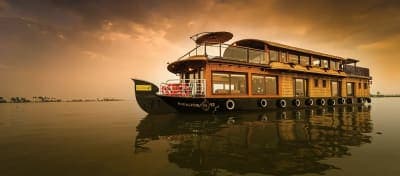
A shared houseboat in Alleppey gives you a private bedroom, exclusively reserved for your booking group, with an attached bathroom and a locking door, on a boat with two or three bedrooms in total. Nobody else ever enters or shares that bedroom. What's shared with other booked guests is the boat's common areas: the dining space and the upper deck. It's the same backwater cruise, the same meals, the same crew, just at a lower cost than chartering a private houseboat.
We run houseboat cruises out of Alleppey, and the question we get most often from solo travellers and budget conscious couples is this: is a shared houseboat actually worth it, or will you regret not paying for a private one? The first thing worth clearing up is what "shared" actually means here. It refers to the common areas of the boat, never your bedroom. After that, the honest answer is that it depends entirely on what you're looking for.
This guide is about the experience itself. What your day actually looks like, who you'll run into in the common areas, what the food is like, and where a shared boat falls short. If you've already decided you want a fully exclusive boat, the private houseboat guide covers that in detail, including options for couples and honeymooners. If you're still deciding, keep reading. This should help you figure out which one actually fits your trip.
Contents
- What a Shared Houseboat Actually Means
- Your Bedroom Is Private. Here's What's Actually Shared
- Who Usually Shares a Houseboat in Alleppey?
- A Day on a Shared Houseboat, From Boarding to Breakfast
- The Honest Pros and Cons
- Shared vs Private Houseboat: Which One Is Right for You?
- Tips for First Time Shared Houseboat Travellers
- Frequently Asked Questions
What a Shared Houseboat Actually Means
A shared houseboat in Alleppey, sometimes called a sharing houseboat by local operators, is not a hostel dorm on water, and it's not a shared bedroom either. That distinction matters more than most articles bother to explain. You book a private bedroom, exclusively reserved for your booking group, complete with an attached bathroom, a proper bed, and a door that locks. No other passenger ever enters it. What you share with other booking groups on the same boat is limited to the common spaces: the dining area where meals are served together, and the open upper deck where most of the scenery watching happens.
The typical shared houseboat in Alappuzha has two or three bedrooms, each booked exclusively by a different individual, couple, or small group. On any given overnight cruise, that might mean two couples, a solo traveller and a couple, or three solo travellers, each with their own private room, coming together only in the common areas when they choose to. The crew, usually two or three people including the captain, handles cooking, navigation, and everything in between.
A good way to picture it is a rented villa shared with people you just met at the airport. Everyone has their own bedroom. You come together in the shared living spaces, the dining table, the deck, because you want to, not because you have to.
Your Bedroom Is Private. Here's What's Actually Shared
Since this is the question we get more than any other, let's be completely direct about it: your booked bedroom on a shared houseboat is yours alone. It's not shared with strangers, other couples, or anyone from another room. Nobody else has access to it, and talking to other guests on the boat is optional, not expected.
Here's the plain breakdown of what "shared" does and doesn't mean:
- Private and exclusive to you: your bedroom, your attached bathroom.
- Shared with other booked guests only: the upper deck and the dining area.
- Never shared, under any circumstance: your bedroom, your bathroom, your bed.
Who Usually Shares a Houseboat in Alleppey?
In practice, the other guests you'll run into in the common areas fall into a few familiar types. Solo travellers who didn't want to pay for an entire boat. Couples folding the backwater experience into a longer Kerala trip while keeping costs sensible. The occasional small group of friends doing Kerala on a budget. And more and more, international backpackers who treat Alleppey as non negotiable. Each of them has their own private bedroom too. You simply share the deck and dining space with them, nothing more.
What most of them have in common is that they came for the backwaters, not for the boat itself. The boat is just the vehicle. The wide, glassy water, the green cover, the odd fishing canoe drifting past, that's what they actually came to see. A shared boat gives you exactly that.
The social dynamic in the common areas tends to be gentler than people expect. There's something about being on water that makes people quieter and more at ease. Conversations happen naturally on the upper deck, usually over chai, usually about where people came from and where they're headed next. Nobody forces it, but it tends to happen anyway. If you'd rather keep to yourself, that's completely fine too. Your private bedroom is always there to retreat to.
A Day on a Shared Houseboat, From Boarding to Breakfast
Check in is at noon, and the afternoon start is deliberate. The boat sets off while lunch is already being prepared: fresh fish curry, rice, a vegetable dish, papad, and something sweet to finish. The food is cooked on board in a small galley kitchen that somehow produces meals that taste like real effort went into them.
The early afternoon cruise moves through open backwater. This is the best time to sit on the upper deck. The sun is still high, the water is still, and the landscape changes just slowly enough to hold your attention. The boat passes narrow canals where coconut palms lean over the water on both sides, small temples right at the water's edge, women washing clothes on stone steps, men in wooden boats pulling in nets. It's the kind of scenery that would feel staged if it weren't so obviously just a Tuesday afternoon in Kerala.
By late afternoon the boat moors somewhere quiet. This is when the day slows all the way down. Some people read on the shared deck. Some head back to their private bedroom instead. The crew brings out banana fritters and tea around five, without anyone asking. Dinner comes after dark, a proper Kerala spread, sometimes a different fish than lunch, always more rice than you thought you'd eat.
The nights on the backwaters are genuinely quiet, in a way that's hard to describe without sounding like a brochure. No traffic. No city noise. Just water, insects, and every now and then a distant temple bell. Once you're back in your private bedroom for the night, it's entirely your own space. The AC runs through the night and the door locks. Sleep tends to come easy.
Morning is slow and unhurried. The boat starts moving again around eight. Breakfast is served in the shared dining area: appam or idiyappam with coconut milk, sometimes a Kerala style omelette. You sit on the upper deck and watch the backwaters in early light, which looks completely different from the afternoon version. Check out is by nine, and most people leave a little reluctant.
👉 Check shared houseboat availability for your dates
The Honest Pros and Cons
What works well
- The full backwater experience at a lower cost. The scenery, the Kerala meals, the overnight stay, none of it is diluted just because you're sharing the boat's common areas. You're on the same water, watching the same sunset, eating the same food.
- Full privacy in your own bedroom. Your room is yours, entirely. Your bathroom is yours too. You're never required to share your bedroom or bed with anyone outside your own booking group.
- Good company, entirely by choice. Some of the better travel conversations happen on a boat with someone you've just met in the common areas, with no agenda at all. It doesn't always happen, and you're never obligated to join in, but when it does, people tend to remember it for years.
- Less pressure to plan everything. On a private boat, every detail is yours to decide, which also means every decision is yours to make. On a shared boat, the structure is already set. For a lot of travellers, that's genuinely a relief.
Where to keep your expectations realistic
- Fixed menu. The food is good, but it's a set Kerala meal. If you have strong dietary restrictions or very particular preferences, a private boat gives you more control. Still, you can always mention allergies or vegetarian needs when you book, and the crew will accommodate within reason.
- Fixed timing. Check in and check out times are standard, and the cruise schedule follows the group's overall rhythm rather than yours alone. If you want to leave at 7 AM or linger longer at one particular canal, a private boat gives you that flexibility.
- Shared common areas, not shared bedrooms. If you'd rather not share the deck or dining space with anyone at all, even though your bedroom stays private regardless, a private houseboat gives you the entire boat to yourselves, which matters most in peak season when both bedrooms on a shared boat are booked.
- You can't choose who else books the boat. This is the one genuine variable, and it only affects who you might see in the common areas, never who's in your bedroom. Most of the time it's fine. Sometimes it's better than expected. Very rarely, it isn't. That's the honest truth, and anyone who claims otherwise is guessing.
👉 See current shared houseboat inclusions and pricing
Shared vs Private Houseboat: Which One Is Right for You?
| Feature | Shared Houseboat | Private Houseboat |
|---|---|---|
| Bedroom | Private to your booking group | Private to your booking group |
| Bedroom shared with strangers | No | No |
| Upper deck | Shared with other booked guests | Exclusive to your group |
| Common dining area | Shared | Exclusive to your group |
| Cruise experience | Shared boat experience | Exclusive boat experience |
| Booking arrangement | Book your room | Book the entire boat |
A shared houseboat makes sense if you're travelling solo, you're a couple watching your budget, you don't mind, or genuinely enjoy, sharing the deck and dining space with other booked guests, or you just want the core backwater experience without paying to charter the whole boat. Your bedroom stays private either way. It's simply a different experience, not a lesser one.
A private houseboat makes more sense if you're travelling as a family, you want the entire boat, common areas included, kept exclusive to your group, you're celebrating a honeymoon or anniversary or any occasion where privacy throughout matters, or you'd rather just pay more to know exactly who's on board. The private houseboat guide covers all of this in detail, including what's included, how pricing works across categories, and what couples and honeymooners specifically should expect.
Tips for First Time Shared Houseboat Travellers
- Pack light. The cabins are comfortable but not big. A medium backpack or small rolling bag is plenty. You won't need your full suitcase.
- Bring sunscreen and a light layer. The upper deck gets direct afternoon sun, and evenings on the water are cooler than you'd expect, even in summer.
- Mention dietary needs when you book, not when you arrive. It gives the crew time to actually prepare for it.
- Leave your schedule behind. The whole appeal of a houseboat cruise is that it moves at a pace you don't control. Fighting that pace is the most common mistake first timers make.
- The upper deck at dawn is worth the early alarm. Most guests skip it. The ones who don't usually call it the best part of the trip.
- October to February is the ideal window for clear weather and calm water. Monsoon season, June to August, has its own moody appeal if you don't mind rain on the deck, but it's a different kind of trip altogether.
Frequently Asked Questions
Do I have to share my bedroom with strangers on a shared houseboat in Alleppey?
No. At Backwater Holidays, your booked bedroom is exclusively reserved for your booking group. You do not share your private bedroom with other passengers. Only designated common areas, such as the dining area and upper deck, are shared with guests who have booked other rooms on the same houseboat.
Do I get my own room on a shared houseboat?
Yes. You book a private bedroom with an attached bathroom, reserved exclusively for your booking group. What you share with other booked guests are the common areas, the dining space and the upper deck, never your bedroom.
Is a shared houseboat good for couples?
Yes, and your bedroom stays private to just the two of you. No other passengers are ever in it. The "shared" part refers only to the common areas, like the deck and dining space. If you'd rather not share those common areas at all, a private houseboat gives you an exclusive boat. The private houseboat guide explains exactly what that looks like for couples.
Is food included?
Yes. A standard Kerala menu is served for all guests: lunch while cruising, evening snacks, dinner, and breakfast the following morning. The menu is fixed, so if you have dietary restrictions, mention them when you book rather than on the day.
Can I book a shared houseboat as a solo traveller?
Yes, and it's one of the best uses of the shared format. You get your own private bedroom at a single room rate. You're never placed in a room with another passenger, and the atmosphere in the common areas tends to suit solo travellers well.
What is the check-in and check-out time?
Check in is typically at noon. The boat cruises through the afternoon and evening, moors overnight, and check out is by 9 AM the following morning after a morning cruise and breakfast.
Is AC available?
Yes. AC runs in your private bedroom through the night, typically from 9 PM to 6 AM. The common areas and upper deck are open air.
How much does a shared houseboat in Alleppey cost?
Shared houseboat pricing depends on the season, the category of boat, and the number of guests, but because you're paying for your own private room rather than chartering the whole boat, it's typically a fraction of what a comparable private houseboat costs for the same route and duration. For an exact, current quote for your travel dates, it's best to check directly rather than rely on a number that might be out of date by the time you travel.
Are shared houseboats in Alleppey safe?
Shared houseboat cruises are a well established part of Alleppey's tourism circuit, and they run under the same crew, navigation, and mooring practices used across the backwaters. If safety equipment, licensing, or specific onboard procedures matter to your decision, we're happy to answer those directly when you enquire.
How far in advance should I book?
For October to February, peak season, book at least two weeks ahead. December and early January fill up fast. For other months, a few days' notice is usually enough, though earlier is always better.